Data science is making an enormous impact on science and society, but its success is uncovering pressing new challenges that stand in the way of further progress. Outcomes and decisions arising from many machine learning processes are not robust to errors and corruption in the data; data science algorithms are yielding biased and unfair outcomes, as concerns about data privacy continue to mount; and machine learning systems suited to dynamic, interactive environments are less well developed than corresponding tools for static problems. Only by an appeal to the foundations of data science can we understand and address challenges such as these.
Building on the work of three TRIPODS Phase I institutes, the new Institute for Foundations of Data Science (IFDS) brings together researchers from the Universities of Washington, Wisconsin-Madison, California-Santa Cruz, and Chicago, with the goal of tackling these critical issues. IFDS organizes its research around four core themes: complexity, robustness, closed-loop data science, and ethics and algorithms. By making concerted progress on these fundamental fronts, IFDS aims to lower several of the barriers to better understanding of data science methodology and to its improved effectiveness and wider relevance to application areas. In concert with its research agenda, IFDS engages the data science community through workshops, summer schools, and hackathons, and is committed to equity and inclusion through extensive plans for outreach to traditionally underrepresented groups.
University of Washington
University of Wisconsin
Madison
University of Chicago
University of California
Santa Cruz
Complexity
Robustness
Closed-loop
Data Science
Ethics & Algorithms
The Latest

Maryam Fazel Receives the 2025 Farkas Prize
IFDS director Maryam Fazel received the 2025 Farkas Prize from the INFORMS Optimization Society. The Farkas Prize is an annual award honoring a mid-career researcher for outstanding, career-spanning contributions to the field of optimization. Fazel was recognized for her foundational work in optimization and pioneering contributions to data science and artificial intelligence." INFORMS citation
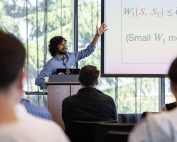
IFDS workshop brings together experts to help make AI more reliable, robust, and trustworthy
The Institute for Foundations of Data Science (IFDS) brought AI and machine learning experts from across the nation to the University of Washington to discuss and explore the mathematical, statistical, and algorithmic underpinnings of modern AI systems. The IFDS Workshop on Theoretical Foundations of Applied AI was held in August 2025 at the Bill & Melinda Gates Center for Computer Science & Engineering on the UW campus.

The recorded talks on “Theoretical Foundations of Applied AI” now available
A big thank you to the workshop co-organizers: Zaid Harchaoui (UWash), Kevin Jamieson (UWash), Robert Nowak (UWisc), and Maryam Fazel (UWash).
Announcing the IFDS Workshop on “Theoretical Foundations of Applied AI” at the University of Washington, August 13-15, 2025
This workshop brings together a diverse group of theoreticians and applied researchers to explore the theoretical underpinnings behind the successes and limitations of modern AI.